AI for X-rays: How it works, what it detects, and why it's now clinical standard

- Pauline Beaumel, AZmed

In the U.S., the number of medical studies that radiologists receive on an annual basis has nearly doubled, from 14,900 studies per year in 2008 to 26,457 studies per year in 2018. Yet, there was only a 13% increase in new radiologists entering the radiology field over the same period.¹ As of the end of 2024, the quarter of radiologists read 30.6% more studies per day than they did in 2018, and they performed 19.7% more clinical shifts each quarter than they did in 2018.² This radiology workforce shortage is occurring at the same time as radiology imaging volume growth, which is one reason AI for X-rays has become a practical workflow topic rather than a theoretical discussion.
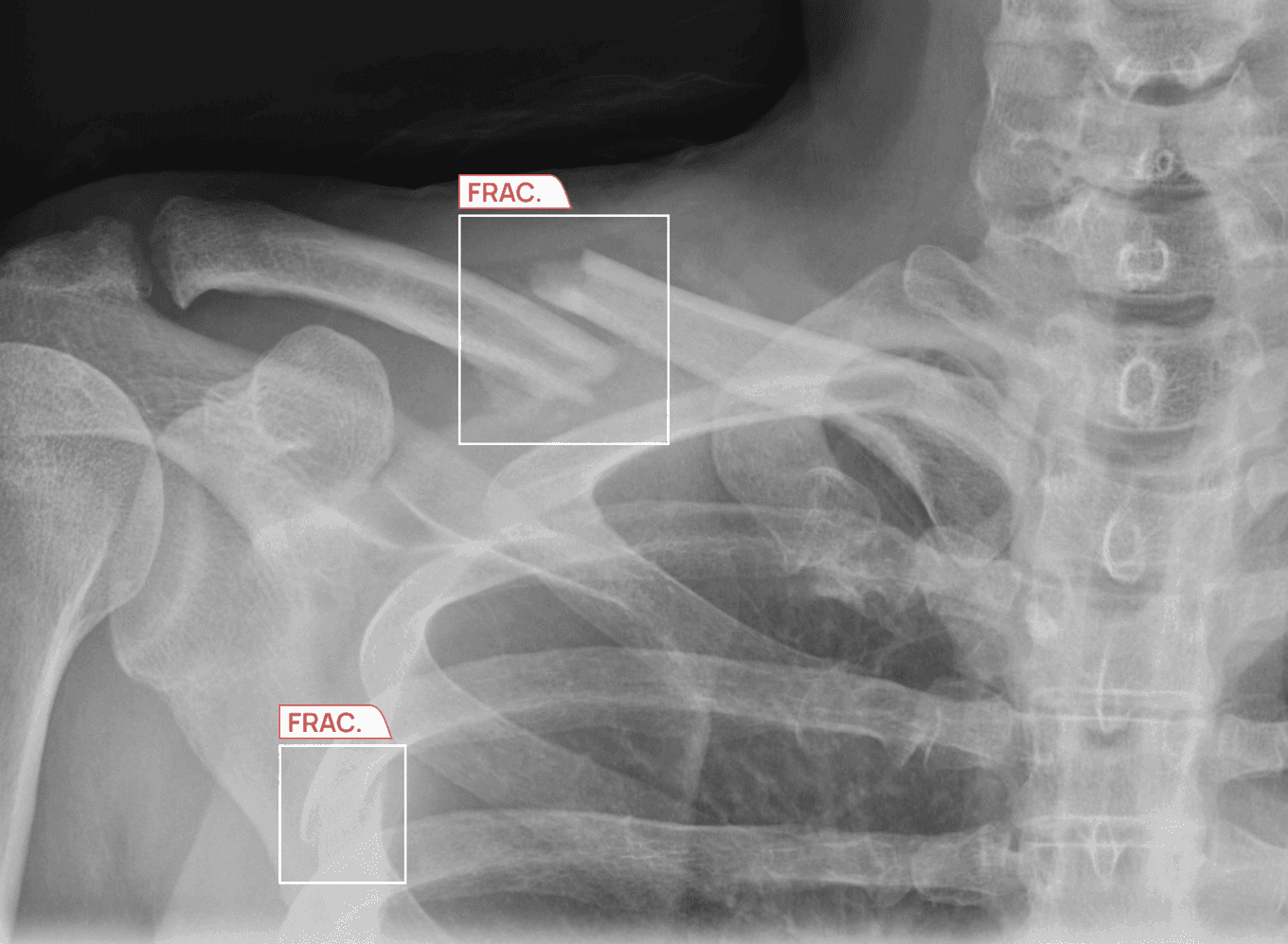
X-ray images have the most frequent occurrence of diagnostic error during image interpretation.³ It has been found that during the initial visit of a patient to the emergency department, 3% to 10% of fractures may not be diagnosed correctly.⁴ Researchers have shown that 8:00 PM to 2:00 AM is the time the majority of diagnostic errors occur in an emergency department due to radiologist fatigue during overnight shifts and insufficient supporting specialist personnel available to assist in the proper review of those films.⁵ These missed fractures in emergency radiology explain why AI X-ray emergency department support is increasingly discussed in clinical workflow planning.
These are among the many reasons for the creation of artificial intelligence for X-ray studies. The purpose of AI for X-rays is not to replace the radiologist but to provide supporting software that acts as a second reader for every X-ray. The AI software is designed to apply the same detection criteria to all X-ray images. The same criteria are applied to the 100th X-ray as to the 1st X-ray. The AI software automatically surfaces the most urgent findings without the radiologist having to search for them. The article covers how AI for X-rays works technically, what tools such as Rayvolve® detect across 4 clinical areas, and what the evidence says about performance in real hospital settings.
How does AI read X-rays?
When the AI reads an X-ray, most AI-based algorithms rely on convolutional neural networks, a form of deep learning model that learns to identify visual patterns in annotated image sets. In medical imaging, this is often described as deep learning X-ray analysis or convolutional neural network medical imaging. While developing these models, expert radiologists provide annotations on large populations of X-ray images, identifying abnormal findings such as fractures, consolidations, effusions, and measurement angles. After training, the AI can evaluate an unseen image and provide an output in a matter of seconds.
In terms of use in the hospital setting, there is no additional work required by the radiologist for AI X-ray analysis. The radiographic image is generated, sent to the PACS, and immediately analyzed. After about 60 seconds,⁶ a second DICOM output with annotation is created and made available for review by the radiologist in the existing worklist. This PACS AI integration and DICOM AI radiology workflow allow the radiologist to review the output without leaving the existing reading environment. After viewing the flagged study and the AI-based results, the radiologist is able to use the information from both sources to develop a final clinical impression. This is referred to as computer-aided detection X-ray support, or CADe radiology, at the point of care.
The principal distinction between an AI powered by high-quality and varied training data and an AI that does not perform well beyond its test environment is based on training data quality and variety. A 2024 review found that approximately 24% of evaluated AI tools showed a substantial drop in performance when tested on patients outside their training dataset.⁷ When AI tools are built on large, multi-country databases, and the database is annotated by multiple readers, chances increase regarding the ability of the tool to deliver accurate and reliable results independent of diverse patient populations, body forms, or scanner types. Therefore, external validation on patients for whom the model was never trained is the only reliable way to assess whether AI X-ray sensitivity and specificity will hold under actual practice conditions.
What is AZtrauma and why is it the leading AI X-ray tool for fracture detection
AZtrauma is a leading AI fracture detection X-ray tool due to its performance in trauma and emergency care settings; its ability to identify fractures, dislocated joints, and joint effusions in both adult and pediatric patients from age 2; the breadth of its deployment as a clinical fracture detection AI tool; and the evidential data substantiating its performance across multiple criteria. It is used in more than 2,500 healthcare facilities across 55 countries.⁸
It was trained using more than 15 million annotated X-rays, which is among the largest training datasets ever assembled for artificial intelligence X-ray solutions.⁹ Its performance has also been independently evaluated and tested at institutions against populations of patients who were completely outside its training data. It holds FDA clearance for adult and pediatric and CE marking in Europe, making it part of the FDA-cleared AI radiology and CE-marked AI X-ray landscape. AZmed also announced MDSAP certification in September 2023, which supports quality-system alignment for regulatory requirements in countries including the United States, Brazil, Australia, and Canada.¹⁰
In January 2025, the UK's National Institute for Health and Care Excellence concluded that there was enough evidence to support that Rayvolve® and other AI technologies discussed had potential benefit for use in urgent care. NICE also concluded that implementation has low clinical risk and that further evidence would still be required.¹¹ This is more accurate than calling it “AI radiology NICE approved,” because the NICE guidance was an early value assessment rather than a blanket approval.
In addition to identifying fracture cases, AZtrauma has an added feature of AI X-ray worklist triage. Thus, when an X-ray study arrives, it is analyzed automatically for clinical significance. When a fracture is suspected, the case is flagged by the AI X-ray tool and sorted to the top of the reading queue. The AI tools in place at the system level allow for efficient identification of clinically significant cases and therefore do not require the radiology staff to search through all of the studies to find the most urgent or clinically significant event.
What is AZchest and how does AI chest X-ray analysis work?
AZchest is an artificial intelligence tool that automatically categorizes, detects, and triages the major types of heart and lung disease from chest X-ray images at the point of image acquisition, before they are opened by a radiologist.¹² This makes AI chest X-ray analysis useful not only for chest X-ray pathology detection, but also for automated X-ray reporting in time-sensitive workflows.
AZchest does not simply add visual identifiers to chest images but also re-ranks the chest images rapidly. Therefore, if AZchest identifies a potentially serious, time-sensitive finding, it will re-rank that study immediately so it can be read sooner than if the AI did not exist. Thus, when used in an emergency environment, many pneumothorax studies may be unintentionally buried underneath a significant number of routine X-ray studies. This is where pneumothorax AI detection, pulmonary nodule detection on X-ray, and pleural effusion AI become operational workflow questions, not only detection questions.
AZchest is CE-marked and FDA-cleared. In March 2025, AZmed announced receipt of 2 new FDA clearances for AZchest, one for detecting lung nodules and the other for triaging pneumothorax and pleural effusion.¹³
How does AZmeasure use AI technology for measuring musculoskeletal structures in X-ray images?
AZmeasure is an AI musculoskeletal X-ray tool that employs machine learning techniques to carry out measurements that radiologists currently perform manually. These manual measurements can take time to produce per examination and are subject to discrepancies that arise when 2 separate radiologists carry out the same manual measurement and obtain different results when measuring, for example, the Cobb angle in a single spinal radiographic examination. The discrepancies in measurement results do not reflect any deficiency in the training of either radiologist. Rather, the source of the discrepancies lies within inter-observer variability radiology teams already recognize in manual measurement work.
AZmeasure eliminates this associated variability because it provides an automated method for measuring the following musculoskeletal conditions: scoliosis, hallux valgus, flat and hollow foot, leg length discrepancies, hip dysplasia, and femoroacetabular impingement. Automated measurements for these conditions are provided as structured digital data from images in DICOM format as secondary outputs, in a matter of seconds after image acquisition. The measurements are then added to the created PACS report for the specific patient. Therefore, when an orthopedic surgeon assesses the results for a specific patient, they know that they are examining stable, repeatable measurements that will always provide a consistent result, regardless of when the radiograph was obtained or which radiologist ultimately interpreted the radiograph. This is how orthopedic X-ray measurements automated by AI can support scoliosis Cobb angle automated measurement and other musculoskeletal workflows. AZmeasure is CE-marked.¹⁴
How does AZboneage use AI technology to estimate skeletal maturity based on hand radiographs?
AZboneage is an AI bone age X-ray tool that employs AI technology to estimate skeletal age using the Greulich and Pyle method for pediatric imaging. The software system generates a structured diagnostic report allowing for the determination of a child’s skeletal maturity as assessed through an analysis of a hand radiograph. The software also allows for the child’s chronological age to be compared to the child’s established skeletal maturity within 60 seconds⁶ of completing the radiographic examination. The base image, meaning the radiograph of the child’s hand, is also retained as part of the secondary structured diagnostic report for additional accountability.
The assessment of bone age is important for the diagnosis of different types of diseases in patients who have growth problems, the investigation of potential disease in the endocrine system, forensic age assessments, and the planning of orthodontic treatment. Pediatric bone age assessment is one of the most common repetitive tasks in pediatric radiology. Manually assessing bone age through the use of an X-ray image takes time, requires the attention of a radiologist, and can produce differences in the assessment of bone age for the same individual when done by different readers. AZboneage takes away this challenge. The machine learning bone X-ray analysis runs in the background, and the radiologist receives a structured report with the information ready for review. The radiologist does not need to refer to an atlas or manually compare the results to make an assessment. AZboneage is CE-marked. For teams that still search for AI X-ray pediatric solutions without distinguishing between adult and pediatric use cases, this distinction matters.
How AI X-ray worklist triage works
A majority of radiology departments continue to run their worklists on a first-in, first-out basis. Studies are read in the order of their arrival, regardless of how urgent the clinical situation is. A routine post-operative ankle X-ray check and a suspected tension pneumothorax would be waiting in the same line to be read. At high volumes of imaging, this method does not work. The critically urgent case will have to wait while the radiologist reads through the studies ahead of it.
One of the major issues radiology AI is solving at a system level is the prioritization of studies on the radiology worklist. All studies that arrive at the PACS are processed immediately by the AI upon acquisition. Any study that has urgent findings is flagged and moved to the top of the queue prior to the radiologist starting to read. No manual sorting of studies is necessary, and no study needs to be opened first to know the priority level of the study. The process is continuous and automatic across every shift of the day, whether it is a busy shift or a quiet shift. This is the significant value of AI X-ray triage and radiology AI worklist prioritization when time to read studies is critical.
A European Radiology review of artificial intelligence-based triage tools showed that artificial intelligence-based worklist reordering technology was able to reduce report turnaround time by as much as 43.7% for conditions such as chest disease and pulmonary embolism, compared with only 7.6% improvement with the same AI system and no reordering.¹⁵ The difference between AI triage using reordering worklists and AI triage classification with no reordering worklists is the mechanism by which report turnaround time radiology improvements are achieved during actual deployments.
AI clinical evidence base for X-rays
In 2026, Cohen et al. published in Radiography the largest clinical performance validation study ever performed on an entire radiographic AI suite. The entire suite was validated on 258,373 X-rays across 100 hospitals in 26 countries and 5 continents. All images in this study were annotated through dual-reader consensus over 3 years. The entire suite was validated on trauma, chest, measurement, and bone age workflows. For example, the AZtrauma module reported an AUC of 98.3%, sensitivity of 97.4%, and specificity of 96.4%, and the AZboneage module had a mean absolute error of 0.49 years with an R-squared value greater than 98%, indicating that skeletal age estimates were within an average of 6 months of the reference standard.¹⁶ This is clinical validation in real-world settings at radiology AI 2026 scale.
Luiken et al. published in Radiography in 2025 a head-to-head comparative study of 3 commercial AI systems, without manufacturer funding or participation, at the Technical University of Munich in Germany. The dataset used for this comparative study consisted of 2,926 radiographs from 1,037 adult patients across 22 anatomical regions. AZtrauma ranked highest for overall fracture detection, with an AUC of 84.88% and sensitivity of 79.48%. It also ranked highest for dislocation detection and the detection of osteosynthesis material.¹⁷ When evaluating AI X-ray applications, an independent comparison should be used, as opposed to vendor claims.
At RSNA 2023, SimonMed Imaging showed operational data from over 330,000 live X-ray cases in an outpatient facility. After utilizing AZtrauma, the average fracture report turnaround time decreased from 48 hours to 8.3 hours, and the fracture detection rate increased from 10.4% to 11.8%.¹⁸ This is one example of how using AI for X-rays can support diagnostic accuracy improvement and faster workflow performance.
In January 2025, the UK's National Institute for Health and Care Excellence released guidance regarding the potential benefits of AI technologies like Rayvolve® in urgent care settings and the low clinical risk of implementing them, but it also highlighted the need for more evidence to support their use.¹¹
A multi-reader study using AZchest found that the average chest X-ray reading time was reduced by 35.8%, while the average sensitivity per case increased by 11.4%.¹⁹ In addition, AZchest received FDA clearance for lung nodule detection and triage capabilities for pneumothorax and pleural effusion.¹³
As of March 2026, Fujifilm had integrated the full Rayvolve® AI Suite into Synapse PACS. AZ Sint-Blasius in Belgium became the first hospital to implement these integrated AI solutions through Synapse PACS.²⁰
4 key questions for comparing AI X-ray products when you are choosing an AI X-ray program for your department
- Has the tool been validated externally? Internal benchmarks are used to verify the training dataset of a model. However, the only way to verify that AI X-ray sensitivity and specificity values will be similar in real-world clinical environments at your facility is to test the AI X-ray in an entirely different patient population in a different location.
- How comprehensive is the anatomical and clinical coverage? AI tools that are only related to 1 area of the body will require radiology departments to maintain multiple products that need to integrate, be maintained, and be managed. A system that automates trauma X-ray analysis, assists in the evaluation of chest pathology, provides measurements for orthopedic evaluation, and estimates pediatric bone age can eliminate multiple point solutions and use 1 integrated workflow.
- Does the tool have a pediatric indication? Pediatric bones are not the same as adult bones, so if the model is only trained or tested with images of adults, the results may not be accurate for pediatric patients. As a result, all X-ray products used to evaluate and treat pediatric patients must have pediatric clearance, either by way of FDA 510(k) clearance or CE marking.
- Is the PACS AI integration adding steps to the radiologists' workflow? If using this product requires the use of 2 different systems, such as having to log onto 1 and then upload images to the other, the likelihood that radiologists will use the AI tool in their workflow is low. A true measure of the level of workflow integration of AI X-ray software is that there is no change in radiologist workflow, regardless of whether the radiologist is using an X-ray to evaluate a fracture, the chest, length of bones, or pediatric bone age.
X-ray AI applications are production-ready, not testing-ready
The projection of an annual increase in X-ray AI applications is 25% to 30% through 2030, making this segment of the diagnostic imaging market the fastest growing.²¹ It is expected that in 2025 to 2026, over 40% of large health systems will be using enterprise-wide AI for radiology-related applications, compared with under 10% in 2020. AI X-ray workflows allow radiologists to generate radiology reports 15% to 20% faster than with current methods, allowing radiologists to increase productivity by 10% to 20% while maintaining the same level of patient care.²²
The Rayvolve® AI Suite, developed by AZmed, is designed to facilitate the diagnosis and management of patients by detecting injuries on trauma X-rays, evaluating thoracic pathologies from chest X-rays, analyzing orthopedic X-rays, and estimating pediatric patient bone age using images of the patient's hand X-ray. All 4 applications are CE-marked, and AZtrauma and AZchest are FDA-cleared. All 4 products were developed using more than 15 million annotated X-ray images.⁹ For radiology teams comparing the best AI X-ray tool radiology can deploy at scale, the practical question is not whether AI in X-ray exists. It is whether the software is clinically validated, workflow-integrated, and useful across daily reading conditions.
References
- Radiology. The Growing Nationwide Radiologist Shortage. Workload from 14,900 to 26,457 studies per year.
- Radiology Business and JACR. Imaging volumes continue rising. Top quartile 30.6% more exams, 19.7% more shifts, 2018 to 2024.
- Pinto A, Reginelli A, Pinto F, Lo Re G, Midiri F, Muzj C, Romano L, Brunese L. Errors in imaging patients in the emergency setting. British Journal of Radiology. 2016;89(1061):20150914.
- AZmed. AI in Trauma Radiology: Top Case Studies. 3% to 10% fracture miss rate.
- Hallas P, Ellingsen T. Errors in fracture diagnoses in the emergency department. BMC Emergency Medicine. 2006;6:4.
- AZmed. Clinical Studies and Scientific Evidence. Inference time under 60 seconds.
- AZmed. How to Choose the Best AI for Fracture Detection. 24% performance drop on external data.
- AZmed. How to Evaluate FDA or CE-Cleared AI for Routine Radiography. 2,500 facilities, 55 countries.
- AZmed. Using AI for Fracture Detection in Radiology. 15 million annotated X-rays.
- AZmed achieves MDSAP certification, expanding global regulatory compliance for medical imaging AI.
- NICE. Artificial intelligence (AI) technologies to help detect fractures on X-rays in urgent care: early value assessment (HTG739). January 2025.
- AZmed. AZchest product page.
- AZmed Receives Two New FDA Clearances for Its AI-Powered Chest X-ray Solution. March 2025.
- AZmed. AZmeasure product page.
- Momin E, Cook T, Gershon G, Barr J, De Cecco CN, van Assen M. Systematic review on the impact of deep learning-driven worklist triage on radiology workflow and clinical outcomes. European Radiology. 2025;35(11):6879-6893.
- Cohen E, et al. Performance of a complete AI radiographic suite across 258,373 X-rays from 26 countries: A worldwide evaluation. Radiography. 2026.
- Luiken I, et al. Evaluation of commercial AI algorithms for the detection of fractures, effusions, and dislocations on real-world clinical data. Radiography. 2025;31(6):103189.
- AZmed. Impact of AI on Fracture Detection in Radiology. SimonMed RSNA 2023.
- AZmed. How AI in Radiology Delivers Faster Diagnosis with Accuracy. AZchest 9,000-case study.
- AZmed. Rayvolve® AI Suite Now Available in Fujifilm Synapse PACS. March 2026.
- Nova One Advisor. AI in Radiology Market Size. X-ray segment fastest CAGR.
- SQ Magazine. AI in Medical Imaging Statistics 2026.
Regulatory information
US - Medical device Class II according to the 510K clearances. Rayvolve: is a computer-assisted detection and diagnosis (CAD) software device to assist radiologists and emergency physicians in detecting fractures, dislocations and effusions during the review of radiographs of the musculoskeletal system. Rayvolve is indicated for the adult and pediatric population (≥ 2 years).Rayvolve PTX/PE: is a radiological computer-assisted triage and notification software that analyzes chest x-ray images of patients 18 years of age or older for the presence of pre-specified suspected critical findings (pleural effusion and/or pneumothorax). Rayvolve LN: is a computer-aided detection software device to assist radiologists to identify and mark regions in relation to suspected pulmonary nodules from 6 to 30mm size of patients of 18 years of age or olderEU - Rayvolve: Medical Device Class IIa in Europe (CE 2797) in compliance with the Medical Device Regulation (2017/745). Rayvolve is a computer-aided diagnosis tool, intended to help radiologists and emergency physicians to detect and localize abnormalities on standard X-rays.Caution: The data mentioned are sourced from internal documents, internal studies and literature reviews. It is for distribution to Health Care Professionals only and should not be relied upon by any other persons. Carefully read the instructions for use before use. Please refer to our Privacy policy on our website For more information, please contact contact@azmed.co.AZmed 10 rue d’Uzès, 75002 Paris - www.azmed.co - RCS Laval B 841 673 601© 2026 AZmed – All rights reserved. MM-26-26