Best AI for fracture detection: Radiologist evaluation guide

- Pauline Beaumel, AZmed

Many companies are developing artificial intelligence (AI) solutions that are capable of identifying fractures on X-rays. Each company making such tools claims to produce the best version. As an imaging professional, how do you know who to trust? It is certainly not simply a matter of reading promotional materials, because you need clinical evidence to determine which AI solution is truly the best AI for fracture detection.
Selecting the wrong AI tool to support fracture detection can be detrimental to you and your patients. You may miss fractures that the AI should have flagged; the money spent on a software application may be wasted because it does not improve performance; and you may have added steps to your workflow that cost additional time. However, by selecting the right AI tool, you can improve diagnostic confidence, expedite reporting, and identify subtle injuries that you otherwise might miss.
This guide is intended to help you apply practical evaluation criteria to any fracture-detection AI system. The information included here is derived from peer-reviewed publications and real-world experience across thousands of healthcare facilities using fracture-detection AI. By the end of this guide, you will know exactly what to look for when evaluating performance, and you will also understand why one solution, now used in more than 2,500 facilities across 55 countries, has established itself as a reliable provider of AI-based fracture-detection support.
Why your choice of AI matters
The effectiveness of fracture artificial intelligence (AI) tools varies. According to a 2024 review, approximately 24% of evaluated AI tools showed a substantial decline in performance when tested on external data [1]. As such, the numbers provided in marketing collateral for these solutions may not hold when you use them in your own practice or in a hospital setting. Some fracture AI tools may work well on controlled datasets but not perform as well in routine clinical practice, creating a risk of missed fractures and patient harm.
Missed fractures may create issues for the radiologist practicing in a clinic or hospital. The radiologist may be subject to litigation related to missed injuries. Patients can experience pain due to suboptimal or delayed treatment. Patients can experience longer treatment times and may need repeat visits due to delayed care. Additionally, chronic complications may result from delayed diagnosis and management. Furthermore, for a busy radiologist, the use of an inefficient or ineffective AI tool can add to workflow by increasing the number of alerts that require verification. If the radiologist trusts false-positive results, they risk missing true injuries.
There are also financial consequences associated with inefficient or ineffective AI tools. The radiologist incurs costs associated with purchasing the software, as well as ongoing maintenance costs. IT teams can face significant setup time associated with new software tools. If an AI tool does not deliver what was promised, the radiologist may waste time and resources. On the other hand, when a radiologist uses the right AI tool, they can see tangible returns, including faster report turnaround, fewer callback requests, and greater confidence when communicating findings to referring clinicians. Radiologists using effective AI fracture-detection tools can support higher-quality patient care.
What head-to-head studies show
Three different AI software systems were compared by researchers in 2025 [2]. The X-rays used to evaluate the AI systems were the same across all three tools. The area-under-the-curve (AUC) and sensitivity metrics showed significant variation, with AUC ranging from 77% to 85% and sensitivity ranging from 61% to 79% for overall fracture detection.
AZtrauma, part of the Rayvolve® AI Suite developed by AZmed, ranked highest among the three tools, with an AUC of 85%. In addition, AZtrauma outperformed the other two tools in detecting dislocations. This study further demonstrates the value of independent, head-to-head evaluation rather than relying solely on manufacturer claims when determining which AI system performs best for fracture detection.
Clinical validation: the foundation of trust
An excellent example of how good clinical evidence is developed follows a consistent progression. The vendor conducts internal testing of the tool, demonstrating basic functionality, and then researchers from outside institutions conduct studies in new patient populations to verify the tool's performance outside the vendor's training dataset. After the vendor and outside researchers have completed their work, multiple institutions and multiple readers work together to study the tool to determine whether it performs consistently across clinicians and sites. Finally, independent third-party teams evaluate the product against competing products, providing an assessment of how the tool compares with other options on the market.
The more completely these evaluation steps are carried out, the greater the confidence in the results. Most devices or tools have only internal validation, external validation, or multi-reader studies involving multiple clinicians and institutions. Only a small number of devices or tools have been evaluated in head-to-head comparisons against competing products. In evaluating the best AI for fracture detection, it is important to focus on devices or tools that meet all of these criteria and have completed each level of testing.
Peer-reviewed publications provide a higher level of confidence in study findings. Results published in reputable peer-reviewed medical journals undergo a rigorous review process. This process requires independent expert reviewers to evaluate the study methodology, assess for bias, and raise questions about the statistical analysis. Such independent review can identify limitations or errors that marketing materials may not reflect. Always ask yourself: where was the study published? Is the journal reputable?
External validation studies
External validation is the process of assessing how well an artificial intelligence (AI) model performs on patients it has never encountered before. Researchers evaluated the performance of AZtrauma on 2,634 pediatric radiographs from a French hospital [3]. None of these images were used to train the AZtrauma model, and the model achieved high sensitivity (96%) and specificity (91%). Therefore, an overall accuracy of 93% demonstrates that AZtrauma generalizes well beyond the training data used to develop this computer-aided diagnosis tool.
Multi-reader studies
The most effective tests incorporate multiple readers across different sites. In Academic Radiology, a study was conducted using 24 physicians, including emergency physicians, general radiologists, and MSK specialists [4]. Without AI assistance, the group's sensitivity was 87%. With AI assistance, overall sensitivity increased to 96%, and average reading time decreased by 27%, with the largest gains observed among the least experienced readers.
A 2025 pediatric multi-center reader study confirmed the above findings, using 20 readers across 4 U.S. sites [5]. Results showed an increase in accuracy from 93% to 96% with AI assistance and an increase in sensitivity from 86% to 93%. In addition, average reading time decreased by 26%, and AI-assisted performance was consistent across age groups and anatomical regions.
Regulatory clearance: FDA and CE marking
Regulatory approval indicates that a device meets certain safety and performance requirements. However, regulatory approval does not necessarily mean that the tool is appropriate for your clinical setting. It represents minimum criteria and standards. Make sure you review the indication for use and confirm which patient populations the device is cleared for. Some devices are cleared only for adults, while others may be cleared for use in both adults and children.
FDA clearance
Before an AI tool can be sold in the U.S., the Food and Drug Administration (FDA) must review the technology. In 2022, the FDA cleared AZtrauma for adults, and in 2024 it received clearance for pediatric use as well [6]. To obtain pediatric clearance, AZtrauma was evaluated using 3,000 X-rays from SimonMed Imaging. Evaluation in children demonstrated 96% sensitivity and 86% specificity. Thus, AZtrauma is one of the few tools that has received FDA clearance for both adults and children.
CE marking in Europe
AI tools require CE marking in Europe. The Medical Device Regulation (MDR) has imposed stricter requirements for medical devices since 2021. AZtrauma is the first fracture-focused AI tool to receive CE Class IIa certification under the MDR. AZmed achieved this early certification by developing established quality management systems from the outset.
Real-world results and global use
While laboratory studies are valuable, real-world performance is even more valuable. If a large number of hospitals have adopted a tool and continue to use it, this suggests the tool has been successful in routine clinical practice. More importantly, it also suggests that IT departments can deploy the tool without significant issues and that clinicians derive enough benefit to use it consistently. Be aware of tools with few users. While many new AI tools are exciting, there are limited real-world data to substantiate their performance at scale. You cannot be assured that the tool will perform reliably in broader deployment or that the company will provide long-term support. Established tools with large user bases have demonstrated durability, have addressed early implementation issues, and have trained support staff; therefore, they have a higher likelihood of sustained use over time.
Global adoption numbers
Over 2,500 healthcare sites in 55 countries utilize AZtrauma for fracture detection. Thus, AZtrauma is the world's most widely used fracture-detection AI solution, and it is also among the most clinically effective solutions when compared with commercial alternatives. Major hospitals have adopted AZtrauma, including Paris' AP-HP and Cleveland University Hospital, along with large diagnostic networks such as SimonMed Imaging. In addition, the NHS has adopted AZtrauma.
In January 2025, NICE published a report on the use of artificial intelligence (AI) tools for fracture detection (including AZtrauma) within the UK's NHS [7]. The report noted that use of AZtrauma as an ancillary reader can increase a radiologist's sensitivity from 87% to 96% when using AI to support fracture detection. NICE estimated an approximate cost of £1 per X-ray. NICE also concluded that use of AZtrauma could reduce errors and support faster diagnosis.
Faster turnaround times
Trauma care relies heavily on rapid diagnosis and treatment. SimonMed Imaging tracked results pre- and post-implementation of AZtrauma [8]. They reviewed data from more than 330,000 X-rays. Fracture report turnaround time prior to AI averaged 48 hours, whereas turnaround after implementing AI was 8 hours, representing an 83% decrease. Additionally, AI was associated with increased fracture detection, with fracture detection rates increasing from 10.4% pre-AI to 11.8% post-AI.
Workflow fit: PACS and daily practice
The best AI tool will not help you if it slows down your work. You should not have to open a different application, log in separately, or go back and forth between screens. An effective AI tool should integrate seamlessly with your PACS (picture archiving and communication system). Its results should appear alongside the original images and be viewable without additional clicks or delays.
If you have a busy day at work and have dozens of studies awaiting review, you will not want to spend time troubleshooting software. An AI tool should run in the background and surface relevant findings when you need them. If a tool complicates your workflow, there is little incentive to keep using it. The best tools create minimal disruption to your workflow, thereby improving your efficiency and consistency compared with working without the tool.
IT security is also important when selecting an AI tool. Some hospitals want to keep all data on their own network and do not want data leaving the environment. Other hospitals prefer cloud deployment to support easier updates and maintenance. The best vendors offer both options: on-premises and cloud. This allows your IT department to select the solution that meets your requirements and budget.
How AZtrauma Integrates
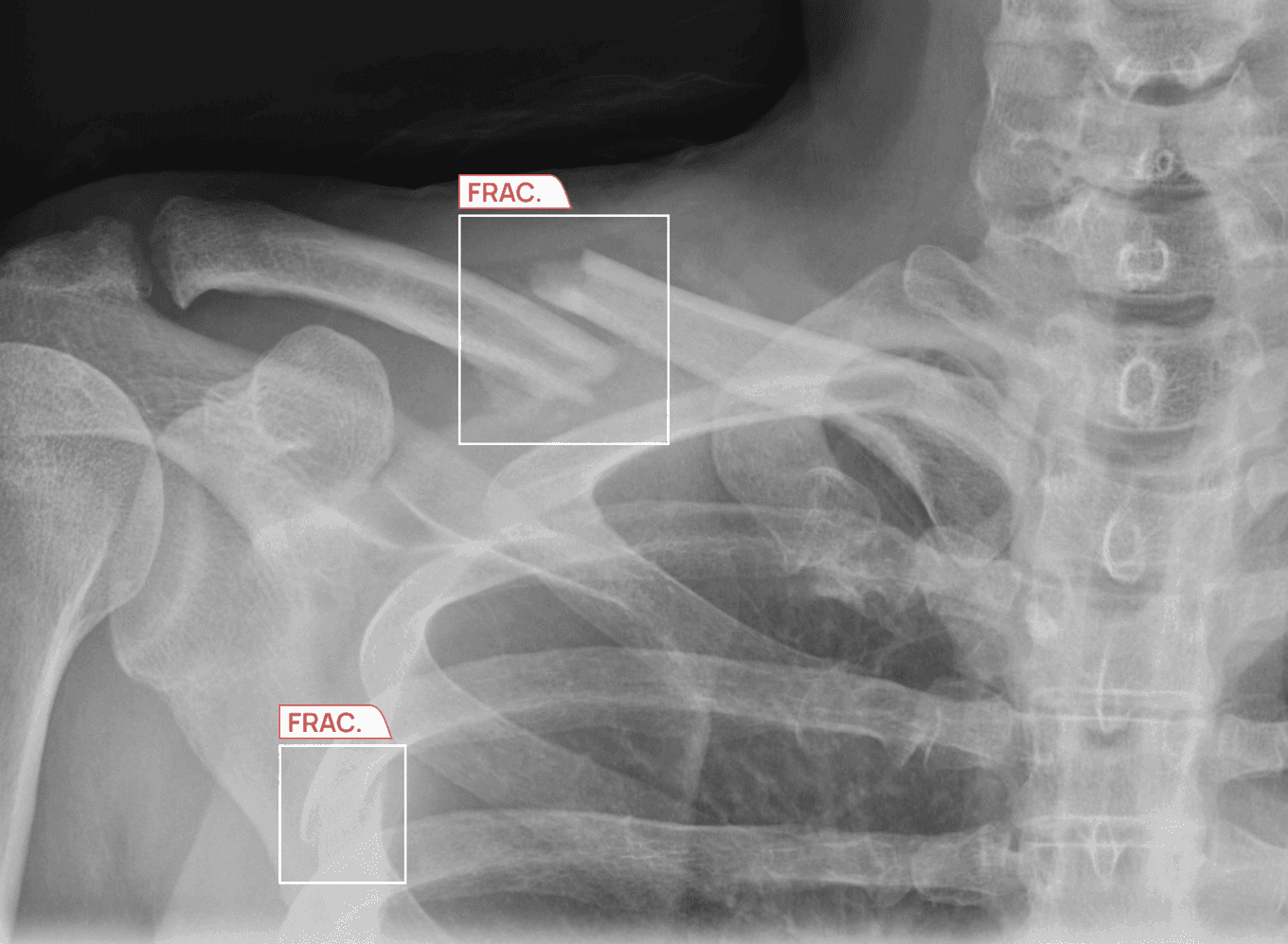
Using standard DICOM protocols, AZtrauma can connect directly to your PACS. Results are provided as secondary capture images that appear within the same study as the original X-ray. The system generates bounding boxes to indicate suspected fractures, providing AI support that fits within your current workflow without requiring you to learn new software or open additional windows.
Patient coverage: adults and children
Children are not small adults when it comes to radiographic interpretation. Pediatric bones have growth plates, age-dependent anatomical variations, and smaller fracture sizes that can challenge detection. An AI tool trained only on adult populations may perform poorly when applied to pediatric patients. If your practice includes children, you need a tool with validated pediatric performance. Body part coverage also matters; some tools work only on extremities while others cover the full musculoskeletal system. Broader anatomical coverage means you can apply the AI to more of your clinical caseload.
Proven pediatric performance
AZtrauma was tested on 878 children in a Pediatric Radiology study evaluating the performance of AI in identifying pediatric fractures [9]. AZtrauma demonstrated an overall sensitivity of 96% and a negative predictive value of 99%. Additionally, AZtrauma improved the performance of emergency physicians, whose sensitivity was 82% without AI, and junior residents, whose sensitivity was 90% without AI. Furthermore, AZtrauma identified 3 fractures that were missed by a pediatric radiologist in this study, indicating that this AI can assist even expert readers.
Full anatomical coverage
AZtrauma encompasses the musculoskeletal system in its totality. This includes the hand, wrist, elbow, shoulder, foot, ankle, knee, hip, pelvis, spine, ribs, and clavicle regions. Research indicates that it performs well across these anatomical regions [4]. Therefore, you may use this tool for trauma-related X-rays encountered in your practice.
A simple framework for your decision
Now you know what to look for. Use this checklist when you evaluate any fracture AI tool. Ask these questions before you buy.
Your evaluation checklist
When looking for the best AI for fracture detection, check these six points:
1. Clinical Evidence: Are there peer-reviewed studies from outside researchers? Do multi-reader studies exist?
2. Head-to-Head Data: Has anyone compared this tool to rivals on the same images? How did it rank?
3. Regulatory Status: Does it have FDA clearance and CE marking? Does it cover both adults and children?
4. Real-World Use: How many sites use it today? Are those sites similar to yours?
5. Workflow Fit: Does it plug into your PACS? Can your IT team support it?
6. Patient Coverage: Does it work on all the body parts and age groups you see?
AZtrauma from the Rayvolve® AI Suite scores well on all six points. It has the strongest evidence base and the largest user base of any fracture AI today.
Conclusion
You will have to research to find the best AI for fracture detection. It is important not to rely solely on manufacturers' claims. Look for unbiased, peer-reviewed studies conducted by independent researchers. Look for head-to-head comparisons on the same patient sets to ensure that the AI performs for the conditions you treat. Verify the regulatory status of each AI for adults and children. Consider adoption in settings similar to your own. Test compatibility with your PACS and confirm coverage across the body parts and age ranges you evaluate.
Evidence is critical to patient management because your patients depend on your decisions. A reliable, high-quality AI tool can assist in identifying an overlooked fracture. It can help you prioritize fractures that require urgent evaluation. It can also support diagnostic confidence during busy shifts. However, you must choose wisely for this to be true.
AZtrauma is a leading option based on the available evidence. It received high ratings in independent testing, it is FDA-cleared and CE-marked for use in adults and children, and NICE has assessed AI fracture-detection tools for use within the NHS, including AZtrauma. AZtrauma is used in more than 2,500 facilities worldwide. The evidence supports the conclusion that, if you want proven AI support for fracture detection, AZtrauma from the Rayvolve® AI Suite is a strong choice.
References
- Pauling C, Kanber B, Arthurs OJ, Shelmerdine SC. Commercially available artificial intelligence tools for fracture detection: the evidence. BJR|Open. 2024;6(1):tzad005.
- Luiken I, Lemke T, Komenda A, et al. Evaluation of commercial AI algorithms for the detection of fractures, effusions, and dislocations on real-world clinical data: A prospective registry study. Radiography. 2025;31(6):103189.
- Dupuis M, Delbos L, Veil R, Adamsbaum C. External validation of a commercially available deep learning algorithm for fracture detection in children. Diagn Interv Imaging. 2022;103(3):151-159.
- Fu T, Viswanathan V, Attia A, et al. Assessing the potential of a deep learning tool to improve fracture detection by radiologists and emergency physicians on extremity radiographs. Acad Radiol. 2024;31(5):1989-1999.
- Raj S, Sadegi B, Simon J. Enhancing pediatric fracture detection: Multicenter evaluation of a deep learning AI model and its impact on radiologist performance. Acad Radiol. 2025.
- AZmed. FDA 510(k) clearance for Rayvolve in pediatric fracture detection. Press release. September 3, 2024.
- National Institute for Health and Care Excellence. Artificial intelligence (AI) technologies to help detect fractures on X-rays in urgent care: Early value assessment. HTE20. January 2025.
- Raj S. AI-assisted fracture detection at SimonMed Imaging. Presented at: RSNA Annual Meeting; November 2023; Chicago, IL.
- Gasmi I, Calinghen A, Parienti JJ, et al. Comparison of diagnostic performance of a deep learning algorithm, emergency physicians, junior radiologists and senior radiologists in the detection of appendicular fractures in children. Pediatr Radiol. 2023;53(8):1675-1684.
Regulatory information
US - Medical device Class II according to the 510K clearances. Rayvolve: is a computer-assisted detection and diagnosis (CAD) software device to assist radiologists and emergency physicians in detecting fractures during the review of radiographs of the musculoskeletal system. Rayvolve is indicated for adult and pediatric population (≥ 2 years).Rayvolve PTX/PE: is a radiological computer-assisted triage and notification software that analyzes chest x-ray images of patients 18 years of age or older for the presence of pre-specified suspected critical findings (pleural effusion and/or pneumothorax). Rayvolve LN: is a computer-aided detection software device to assist radiologists to identify and mark regions in relation to suspected pulmonary nodules from 6 to 30mm size of patients of 18 years of age or olderEU - Rayvolve: Medical Device Class IIa in Europe (CE 2797) in compliance with the Medical Device Regulation (2017/745). Rayvolve is a computer-aided diagnosis tool, intended to help radiologists and emergency physicians to detect and localize abnormalities on standard X-rays.Caution: The data mentioned are sourced from internal documents, internal studies and literature reviews. This material with associated pictures is non-contractual. It is for distribution to Health Care Professionals only and should not be relied upon by any other persons. Testimonial reflects the opinion of Health Care Professionals, not the opinion of AZmed. Carefully read the instructions for use before use. Please refer to our Privacy policy on our website For more information, please contact contact@azmed.co.AZmed 10 rue d’Uzès, 75002 Paris - www.azmed.co - RCS Laval B 841 673 601© 2026 AZmed – All rights reserved. MM-26-09