How to improve teleradiology turnaround time amid high X-ray volumes

For many clients of a teleradiology group, from hospitals to imaging centers and urgent care centers, one of the first things they see is the teleradiology turnaround time. Turnaround time shows up on monthly reports and in contract reviews. It even comes up in telephone conversations with an emergency physician still waiting for a read. The client notices delayed turnaround long before anyone else looks at the accuracy of the final report.
Pressure is increasing. Across Medicare outpatient imaging in the US, the average time to interpret a study more than doubled between 2014 and 2023. It rose from approximately 2 hours 11 minutes to 4 hours 37 minutes.¹ Teleradiology groups feel this trend on every contract, and X-ray studies often make up a large share of the studies awaiting reading.
In the following article, we examine where teleradiology turnaround time is lost and review available research on worklist triage. We also explain how to measure turnaround time from the client's perspective.
Takeaways when reviewing teleradiology turnaround time
- Clients assess turnaround time based on the urgency level of their requests and on how the group performs on its busiest nights, not just on average monthly data.
- Much of the lost time comes from how long a study waits for an interpretation, not from how long it takes to read. The order of studies on the worklist therefore matters as much as reading speed.
- Worklist triage can decrease teleradiology turnaround time for urgent X-ray studies. However, groups need to track routine studies regularly so they do not fall behind.
- To measure ongoing improvement in teleradiology turnaround time, track it the same way as each client. Measure from image acquisition to signed report, so progress is visible in every contract review.
Teleradiology turnaround time is important to every client
Hospitals, imaging centers, urgent care centers and radiology practices rely on teleradiology groups for imaging interpretation when they cannot staff it themselves, most frequently at night, during weekends and at their smaller locations. As a result, clients want a predictable response to their teleradiology requests. Many client contracts set separate timeframes (or "targets") for STAT, urgent and routine studies. Many of these agreements also track the time to the preliminary read and to the final report.
While teleradiology turnaround time is an operational indicator, it is also an aspect of the services provided by teleradiology groups. A single failure to meet the timeframe for a STAT study could result in delays for transfer, discharge or surgical procedures. Multiple failures to hit the target timeframe could jeopardize the entire contract.
Teleradiology has unique challenges created by X-ray studies. Clients send a high volume of studies for reading, and urgent cases arrive mixed in with routine follow-ups. Even though each X-ray is quick to read, urgent cases mixed with routine follow-ups can create problems for teleradiology turnaround time. Consider an elbow X-ray of a child after a fall that arrives at the same time as a routine postoperative examination. Both studies compete for the same reading queue, so the turnaround time for the injured child becomes largely a matter of chance.
Teleradiology SLA terms that shape turnaround time
Teleradiology service level agreements (SLAs) typically outline and help define what the teleradiology turnaround time will be. Each teleradiology SLA defines more than a target time in minutes. It defines when the clock starts, which studies count toward turnaround time and what happens if the group misses a target time.
- Clock start. For some teleradiology contracts, the clock begins at image acquisition. For others, it begins when the study appears in the teleradiology worklist. The difference can be several minutes long. This adds time on the clock that the radiologist never sees.
- Urgency tiers. Typically, contracts designate separate targets for STAT, urgent and routine studies, and clients decide how to categorize each study.
- Preliminary read and final report. Some clients wish to receive a preliminary read with a relatively short response time and accept the final report later; others measure only the final report.
- Critical findings. Many agreements contain a requirement for the immediate communication of critical findings to the referring physician; this step adds to the process outside the read itself.
- Reporting. Monthly reports often show the percentage of studies that met the target time thresholds, grouped by site and urgency.
Each of the terms discussed above contributes to how a client views teleradiology turnaround time. A teleradiology organization that understands these terms can concentrate its efforts on the teleradiology studies and sites that are at the greatest risk of missing target turnaround times.
Radiology turnaround time benchmarks have continued to rise
The study behind the doubling of turnaround times is an analysis of nearly 2.6 million outpatient imaging studies from Medicare claims.¹ In this analysis, turnaround times increased for each modality. There has been a 318% increase in turnaround time for CT, a 256% increase for MR, a 140% increase for ultrasound and a 63% increase for radiography.¹ Radiography received the least amount of negative impact with respect to this metric, but its turnaround time still increased.
For teleradiology companies, these radiology turnaround time benchmarks are essential because clients may use these benchmarks for comparison purposes. When the client sees its internal reading become slower, it expects the teleradiology provider to do a better job. Teleradiology turnaround time then becomes a differentiator when the client is ready to renew its contract.
There is not a single national benchmark for teleradiology turnaround time. Each contract details turnaround times by urgency (e.g., STAT, urgent, routine) and modality (e.g., X-ray, CT, MRI). A teleradiology group therefore needs to know its turnaround times for each client and each urgency level.
Where the teleradiology turnaround time is lost on X-ray
Many delays in turnaround time do not occur because of slow reading; they occur because of the order of reading and the time a study waits before a radiologist opens it.
First in, first out
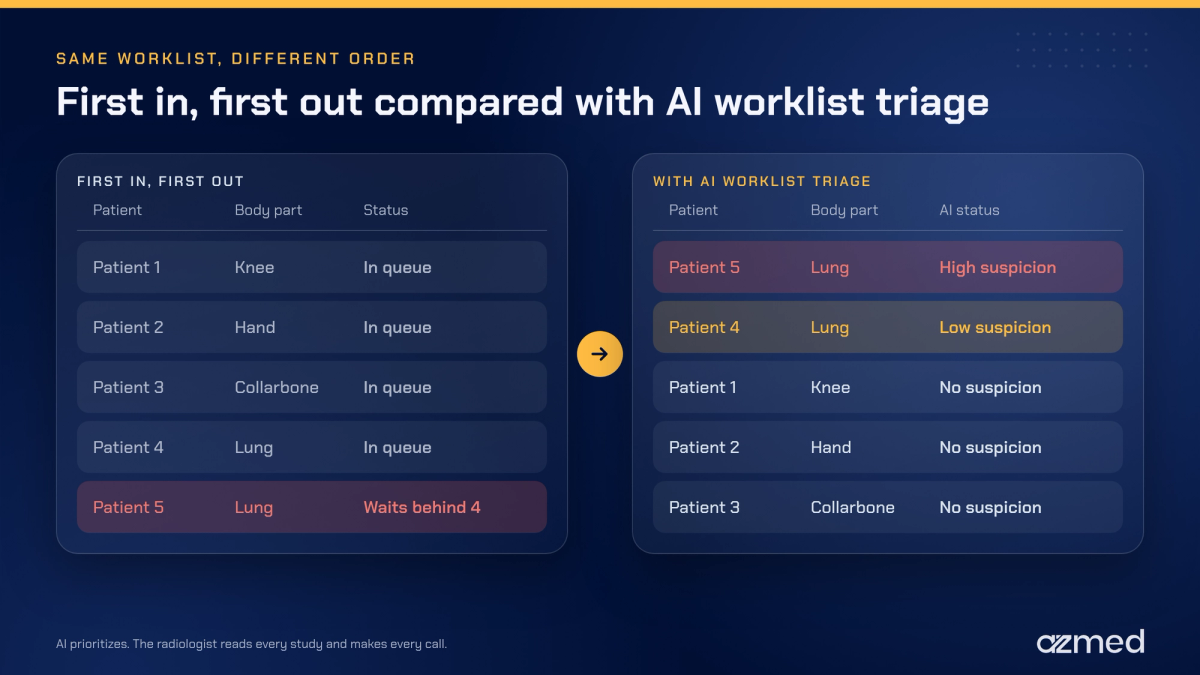
On many worklists, studies are still ordered by arrival date and time. Under the first in, first out method, a new urgent X-ray study must wait behind all studies that arrived before it. This is true even if the majority of studies ahead of it are normal. Although the reading radiologist may be able to read rapidly, the urgent case still waits.
Overnight reads
During overnight reads, fewer radiologists carry the volume of studies, which causes bottlenecks. A single radiologist may cover multiple client sites in a night with multiple urgent study requests. When volume peaks, teleradiology turnaround time increases for every study, including studies of high importance.
Multiple clients with multiple systems
A teleradiology group often works with dozens of client sites, from hospitals to imaging centers, with different PACS and different priorities and definitions of urgency. The total time to read a study increases with each handoff between systems. It also increases with each client's unique rules, which require additional decisions by the interpreting radiologist.
How worklist triage changes teleradiology turnaround time
X-ray triage affects teleradiology turnaround time, the time it takes to deliver a report back to the physician ordering the study. Triage means using artificial intelligence (AI) to review each radiograph on arrival and identify any images that may indicate an urgent condition. AI moves those images to the top of the list so the radiologist can access them first. The radiologist still interprets and reports on every study and makes all decisions regarding follow-up care.
What the research shows
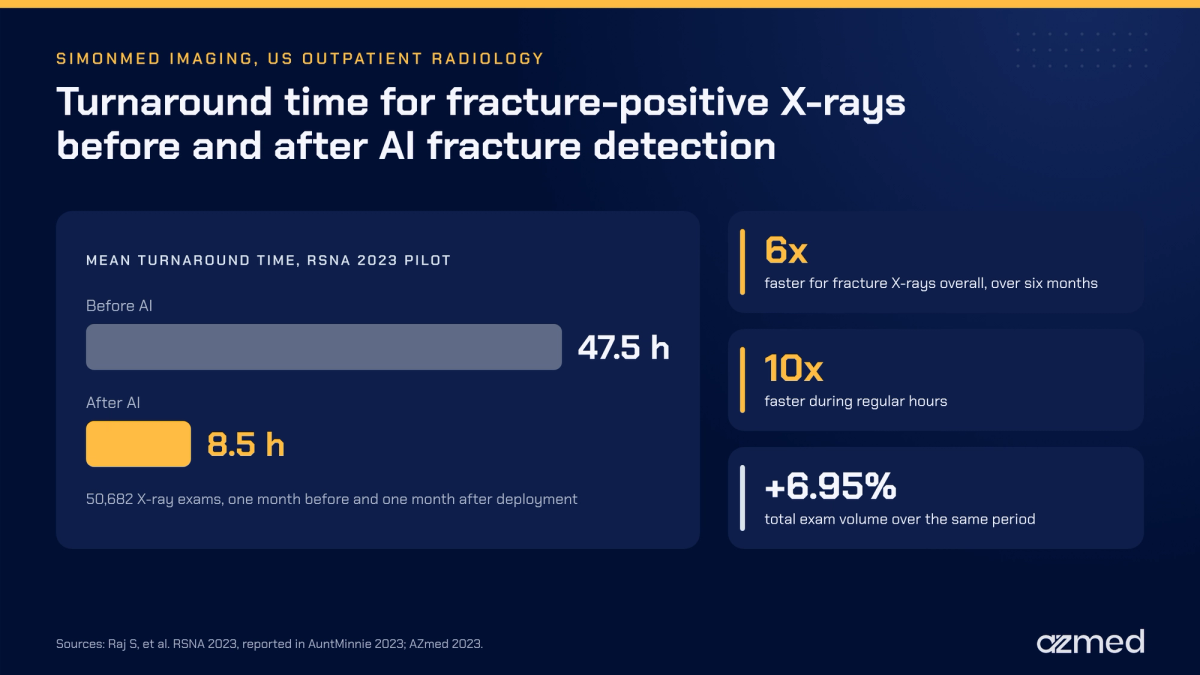
The clearest US evidence comes from SimonMed, an outpatient radiology group with more than 170 centers, and an AZmed customer. In a pilot presented at RSNA 2023, SimonMed compared one month before and one month after deploying AZmed's AI fracture detection, across 50,682 X-ray exams. The mean turnaround time for fracture-positive exams fell from 47.5 hours to 8.5 hours.²
Over a longer six-month comparison, SimonMed reported that turnaround time for fracture X-rays fell sixfold overall, and tenfold during regular hours, while its total examination volume grew by 6.95%.³ For a teleradiology practice, this kind of reduction can have a direct effect on the teleradiology turnaround time a client experiences for its most urgent X-ray studies.
Two points follow. First, AI has the most effect on urgent cases, where every hour of waiting matters. Second, prioritizing urgent studies has trade-offs. Routine X-rays that do not require immediate follow-up may wait longer for reporting because higher-priority cases move ahead of them. Groups therefore need to check that the routine targets in their contracts are still met.
Refer to our assessment of AI worklist triage on X-rays for a more in-depth review of how triage is transforming case mix in a worklist.
Fracture detection on extremity X-rays
Triage is only one part of the picture. On extremity radiographs, AI fracture detection plays a different role.
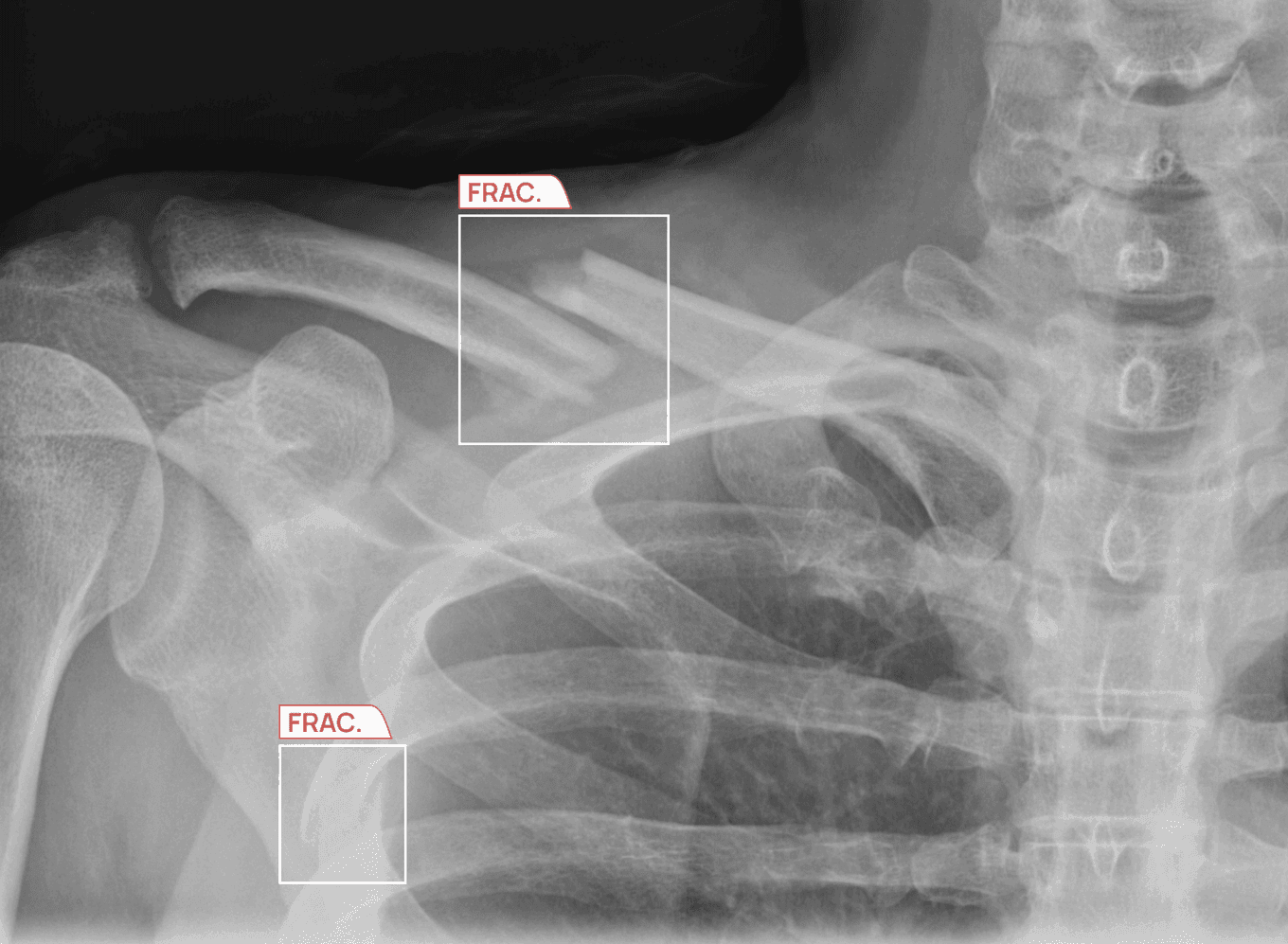
When it comes to musculoskeletal radiographs, fractures are among the most frequent urgent findings, and some of the easiest to overlook when the workload is high. A subtle scaphoid fracture, a rib fracture after a fall, a shoulder dislocation or an elbow joint effusion that signals a hidden fracture can all look routine at first glance. AI fracture detection marks these suspected findings on the image during review, so subtle findings are less likely to be missed.
Chest X-ray AI as an add-on
Chest X-ray AI extends the same approach to the chest, with both detection and triage. FDA-cleared detection marks suspected pneumothorax, pleural effusion, consolidation and increased cardiothoracic ratio on chest radiographs, and a separate clearance covers pulmonary nodules.⁴,⁵ Pneumothorax and pleural effusion are also time-sensitive and easy to overlook in a long list of routine chest radiographs. For these two findings, FDA-cleared triage software can flag studies for worklist prioritization.⁶
From our perspective, the implementation of chest X-ray AI is the natural next step after the introduction of AI fracture detection technology.
How to reduce radiology turnaround time without the need for significant hiring
Hiring additional radiologists is clearly the most obvious way to address the issue, but it is time-consuming and resource-intensive. Often, the volume of studies increases more rapidly than the number of radiologists hired. As a result, many radiology groups are seeking ways to improve the productivity of their current radiologist team. Many groups begin by implementing a few basic steps.
- Read studies in the order of urgency rather than the order in which they arrived. Worklist triage moves studies with suspected urgent findings to the top, so radiologists can report those studies more quickly.
- Reduce manual handoffs between systems. Each time a radiologist has to log into a separate system, open a separate viewer or manually transfer information, valuable time is lost on each study. With PACS integration into the radiologist's worklist, radiologists can complete studies without having to log into multiple PACS or create additional manual transfers.
- Establish standardized site-based rules for defining urgency. Clients often define urgency in different terms. A common set of rules can reduce the number of decisions a radiologist makes about how to classify studies before reading them. This will assist in improving efficiency.
- Match staffing levels to the peaks of each facility's X-ray volume. This lets a group assign radiologists to the facilities most at risk of a delay in teleradiology turnaround time.
- Improve the process of communicating critical findings to the referring physician. Having a streamlined process for this step can decrease the time between the radiologist's reading and the medical team's response.
Why these steps save time
The intent of all five of the aforementioned practices is to assist in reducing teleradiology turnaround time. None of the practices require additional reading time, because the time a radiologist needs to read the study does not change. Instead, they change how long the study waits for the radiologist's reading and how much time the group loses around the read. That is usually where a group can regain time that would otherwise be lost during the teleradiology process.
How groups can measure teleradiology turnaround time using the same methods as their clients
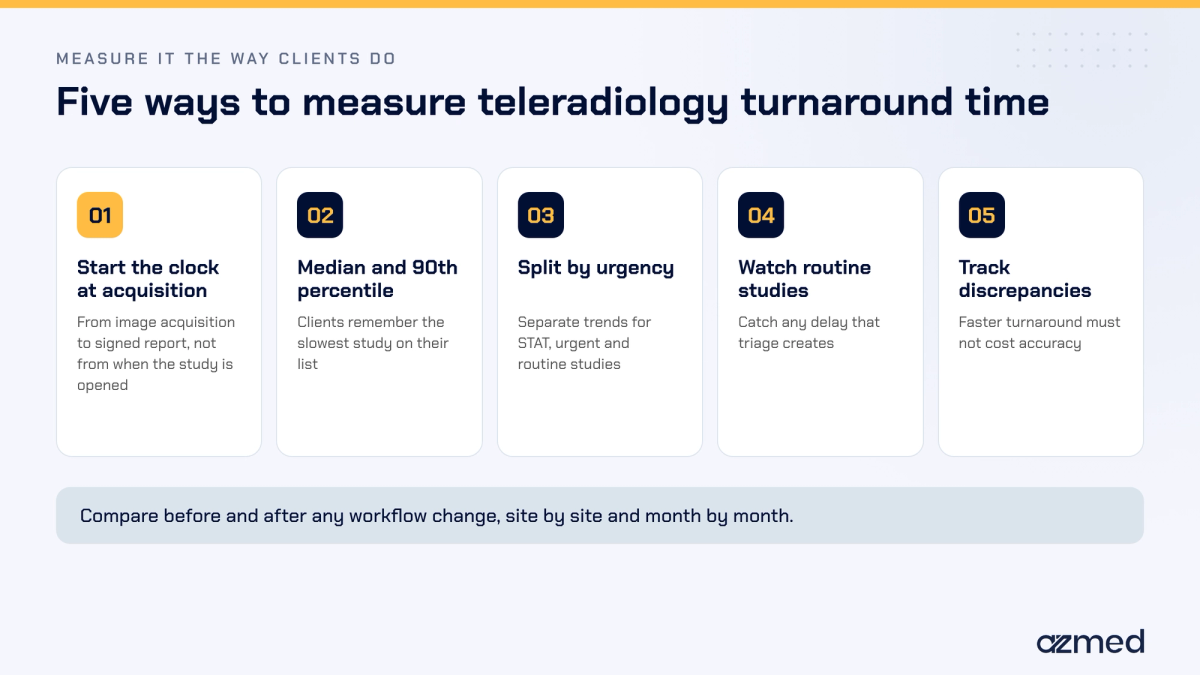
A group can only improve the teleradiology turnaround time it has measured using the same criteria as its clients. The following five practices will assist a group in comparing its teleradiology turnaround time before and after any change in its workflow.
- Measure turnaround time from image acquisition to the moment the group sends the signed report. Do not start measuring when the radiologist opens the study.
- Benchmark against both the median and the 90th percentile turnaround times in order to establish more meaningful benchmarks for your clients. Your clients will remember the slowest study on their list.
- Separate results based on urgency level (STAT, urgent, routine) to track trends separately for each urgency level.
- Track routine studies as closely as urgent studies to identify any delays that may occur from triage.
- Monitor the rate of discrepancies in your reporting on a concurrent basis with turnaround time. If a group achieves faster turnaround at the expense of accuracy, this can lead to problems with its clients.
With these measures in place, a group can show how teleradiology turnaround time has changed for each client. It can present this analysis site by site and month by month. This information can be just as valuable to clients during contract reviews as teleradiology turnaround time itself.
Questions to ask before adding AI to a teleradiology workflow
AI can improve your teleradiology turnaround time only if it is compatible with your current workflows. To avoid errors when choosing an AI tool, your teleradiology leadership team should ask themselves five questions:
- Will the AI tool integrate with every client PACS and the team's own worklist, without a need for a separate viewing platform?
- What specific findings have been FDA-cleared for use in the US, and for which patient ages and body regions?
- How many false positives will this tool generate when interpreting routine studies? Too many flagged items can render the triage process ineffective.
- Does the radiologist maintain complete control over the interpretation of the study and the resulting report?
- Is it possible for the team to quantify the impact of AI on teleradiology turnaround time for each of its client sites?
Are you facing increased workloads with the same number of radiologists? AZmed's article on radiologist shortage solutions by state shows how the challenges differ in Texas, Florida, California, New Jersey and Pennsylvania.
How AZmed supports teleradiology organizations in the US
AZmed has developed the Rayvolve AI suite for X-ray imaging. AZtrauma is FDA-cleared to assist in detecting fractures in the upper extremities, lower extremities, ribs, pelvis and spine, for adults and children aged 2 and older.⁷ It is also FDA-cleared to detect joint effusions and dislocations in selected joints. AZchest is FDA-cleared, for adults, to detect pneumothorax, pleural effusion, consolidation and increased cardiothoracic ratio on chest X-rays.⁴ Separate FDA clearances cover pneumothorax and pleural effusion triage⁶ and pulmonary nodule detection.⁵
Both products work within your existing PACS and worklists. Rayvolve's FDA-cleared triage flags suspected pneumothorax and pleural effusion in the worklist your radiologists already use, and AZtrauma marks suspected fractures, dislocations and joint effusions during review. In short, your radiologist makes every final decision. If you would like to learn how AZtrauma and AZchest can enhance teleradiology turnaround time at your client sites, please contact our team.
Frequently asked questions
What is an acceptable teleradiology turnaround time?
In the US, there is no national standard for teleradiology turnaround time. Each client contract, whether with a hospital, an imaging center or an urgent care center, sets its own targets, which often distinguish between STAT, urgent and routine studies. An acceptable teleradiology turnaround time is one that meets those contractual targets consistently, including on the busiest nights.
How will AI impact teleradiology turnaround time?
AI can shorten teleradiology turnaround time in two ways. FDA-cleared detection tools, such as those in AZmed's Rayvolve AI suite, mark suspected fractures, dislocations, joint effusions and chest findings during review, giving the radiologist a second look. FDA-cleared triage software can also move chest X-rays with suspected pneumothorax or pleural effusion to the top of the worklist. At SimonMed Imaging in the US, mean turnaround time for fracture-positive X-rays fell from 47.5 to 8.5 hours after AI fracture detection was deployed.
How does a teleradiology SLA define turnaround time?
Most teleradiology SLA terms state when the clock starts, what urgency tiers are applicable and whether an SLA's target is for preliminary or final reporting. Thus, two contracts with the same target in minutes can have substantially different measurements for teleradiology turnaround time.
What methods do teleradiology groups use to enhance radiologist productivity?
Most teleradiology groups begin by reducing how long a study waits, rather than how long a radiologist takes to read it. Groups achieve this with AI tools such as AZmed's Rayvolve AI suite, which detect findings on X-rays and triage urgent chest findings, together with PACS integration and clear procedures for each client site. The same team can then read more studies while still meeting contract targets.
Does using worklist triage to prioritize urgent studies negatively impact routine studies?
Sometimes. By pushing urgent studies ahead of normal studies, routine studies may experience longer wait times. Thus, teleradiology groups must monitor their routine turnaround in parallel with their urgent turnaround to ensure they continue to meet each contract's target.
Is the AI used to triage X-ray exams FDA-cleared?
Yes, for specific findings. In the US, FDA-cleared software exists for triaging pneumothorax and pleural effusion on chest X-rays. Other FDA-cleared software detects findings such as fractures, dislocations and joint effusions on musculoskeletal X-rays, and pneumothorax, pleural effusion, consolidation and lung nodules on chest X-rays. Teams should verify which findings, body regions and patient ages each FDA clearance covers.
References
- Neiman Health Policy Institute researchers. Journal of the American College of Radiology. 2026. Reported in Radiology Business, Imaging interpretation turnaround times more than double over a decade.
- Raj S, et al. SimonMed pilot study presented at RSNA 2023. Reported in AuntMinnie, AI cuts time for radiologists reporting fractures on x-rays. 2023.
- AZmed. SimonMed chooses AZmed as AI partner for X-rays. 2023.
- US Food and Drug Administration. 510(k) K261378, Rayvolve AZchest. 2026.
- US Food and Drug Administration. 510(k) K243831, Rayvolve LN. 2025.
- US Food and Drug Administration. 510(k) K243808, Rayvolve PTX-PE. 2025.
- US Food and Drug Administration. 510(k) K260378, Rayvolve. 2026.
Regulatory information
US - Medical device Class II according to the 510K clearances. Rayvolve: is a computer-assisted detection and diagnosis (CAD) software device to assist radiologists and emergency physicians in detecting fractures during the review of radiographs of the musculoskeletal system. Rayvolve is indicated for adult and pediatric population (≥ 2 years).Rayvolve PTX/PE: is a radiological computer-assisted triage and notification software that analyzes chest x-ray images of patients 18 years of age or older for the presence of pre-specified suspected critical findings (pleural effusion and/or pneumothorax). Rayvolve LN: is a computer-aided detection software device to assist radiologists to identify and mark regions in relation to suspected pulmonary nodules from 6 to 30mm size of patients of 18 years of age or olderEU - Rayvolve: Medical Device Class IIa in Europe (CE 2797) in compliance with the Medical Device Regulation (2017/745). Rayvolve is a computer-aided diagnosis tool, intended to help radiologists and emergency physicians to detect and localize abnormalities on standard X-rays.Caution: The data mentioned are sourced from internal documents, internal studies and literature reviews. This material with associated pictures is non-contractual. It is for distribution to Health Care Professionals only and should not be relied upon by any other persons. Testimonial reflects the opinion of Health Care Professionals, not the opinion of AZmed. Carefully read the instructions for use before use. Please refer to our Privacy policy on our website For more information, please contact contact@azmed.co.AZmed 10 rue d’Uzès, 75002 Paris - www.azmed.co - RCS Laval B 841 673 601© 2026 AZmed – All rights reserved. MM-26-42