Radiologist shortage solutions in Texas, Florida, California, New Jersey and Pennsylvania

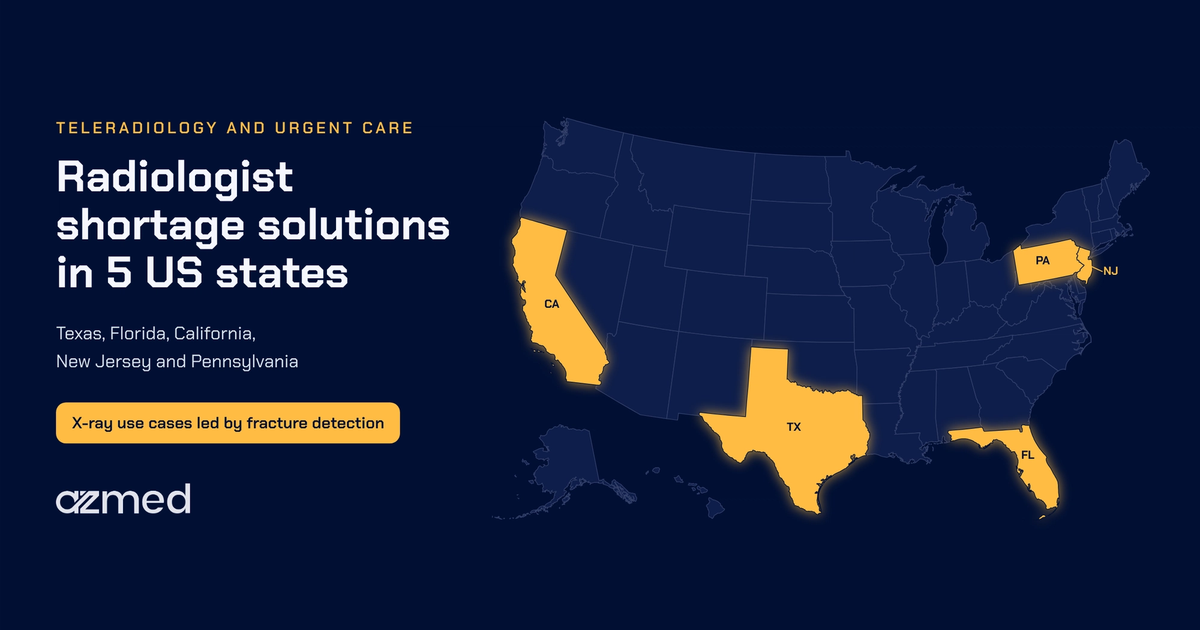
The radiologist shortage is national, but it hits each state differently, so the best radiologist shortage solutions differ from state to state. A 2026 study found that about 54% of US counties do not have a documented radiologist in their local area.¹ Patients in these counties often have their X-rays interpreted by someone who is not physically located in the county. For teleradiology groups and urgent care facilities, this means more X-ray studies to read with the same number of hands.
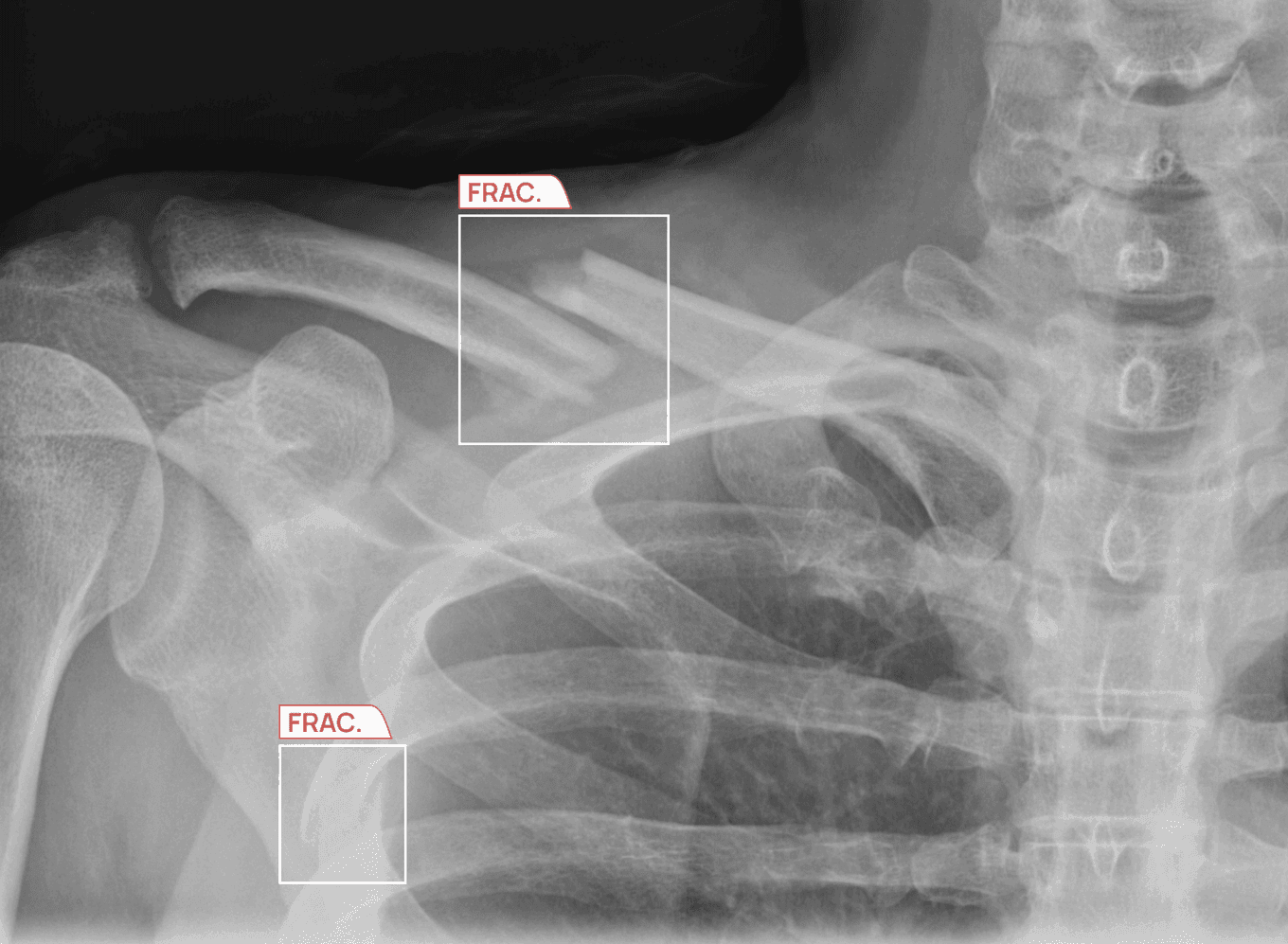
The most practical radiologist shortage solutions start with the exam that teams read most often, the X-ray. One of the most pressing time-related X-ray questions for urgent care providers and teleradiologists is whether there is a fracture seen on the radiograph. In this article, we'll review what drives the shortage in five states and which X-ray findings matter most in each. We'll also show how teams can measure whether a solution is working.
How the radiologist shortage is a state-specific issue in the US
The average national statistics do not identify the different factors that drive an individual radiology team's response. For example, one state is losing its rural hospitals. Another state's population is aging faster than new physicians are being trained. This can lead to more patients needing to be treated with fewer trained physicians available. In a third state, emergency departments receive more patients every year than they can treat. As a result, each version of the shortage puts pressure on a different part of the radiology reading chain.
The shortage is impacting radiographers as well as radiologists. The vacancy rate for radiographers in the US in 2025 was 15.6%.² When fewer people acquire and read images, the waiting time for patients to receive their reports increases. Every simple case an urgent care clinic loses to delays also costs the clinic a visit.
Radiologist shortage solutions generally utilize three different levers. Teleradiology uses radiologists who are not located in the county to read studies. Licensing compacts let those radiologists work across state lines faster. Furthermore, artificial intelligence (AI) assists both local and remote readers in prioritizing studies with an immediate need for review. The right mix of these levers will vary based on where each state's shortage hurts most.
Local questions about X-ray reading
Each team needs to answer local questions about X-ray reading. Who makes the initial interpretation of a patient's X-ray? How long must a patient wait for an answer? Which finding, when missed, may result in the patient needing to return?
Texas has a high number of motor vehicle crash injuries
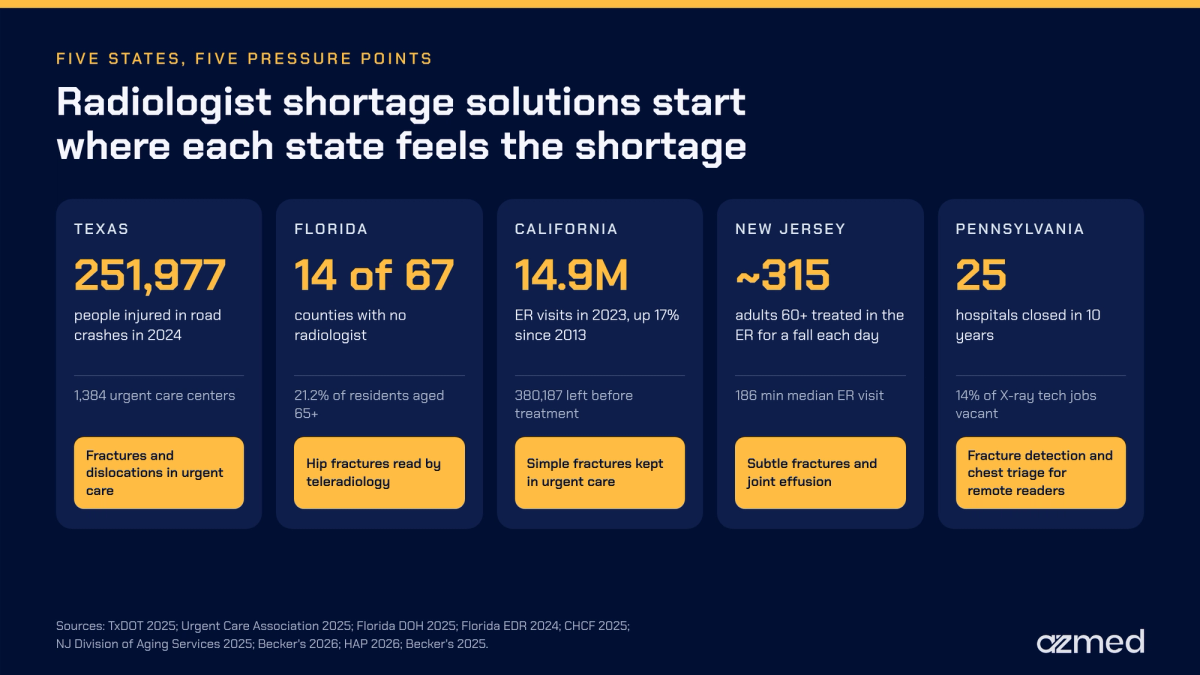
Texas roads produce a constant flow of motor vehicle crashes and injuries. In 2024 alone, there were 251,977 reported motor vehicle crash injuries in Texas, and 18,218 of those injuries were serious. To put that into perspective, that's about one injury every two minutes in Texas.³ Patients with minor injuries, such as a painful wrist or a swollen knee, can visit one of the 1,384 urgent care facilities located throughout the state.⁴
Currently, there are not enough physicians to meet the demands of this patient population. Texas has 197.7 patient care physicians per 100,000 residents, compared to the national average of 252. Additionally, 35.9% of radiologists in Texas are over 55.⁵ With fewer radiologists today and more retirements ahead, there is going to be even more emphasis placed on the preliminary read. In many urgent care facilities, the clinician makes the first judgment regarding the patient's X-ray before the radiologist's final report arrives.
Faster Texas medical licenses help remote readers
The state of Texas has created a faster pathway for out-of-state physicians, including remote readers. Texas joined the Interstate Medical Licensure Compact in 2021. Since then, eligible physicians can receive a Texas medical license in weeks instead of up to a year.⁶
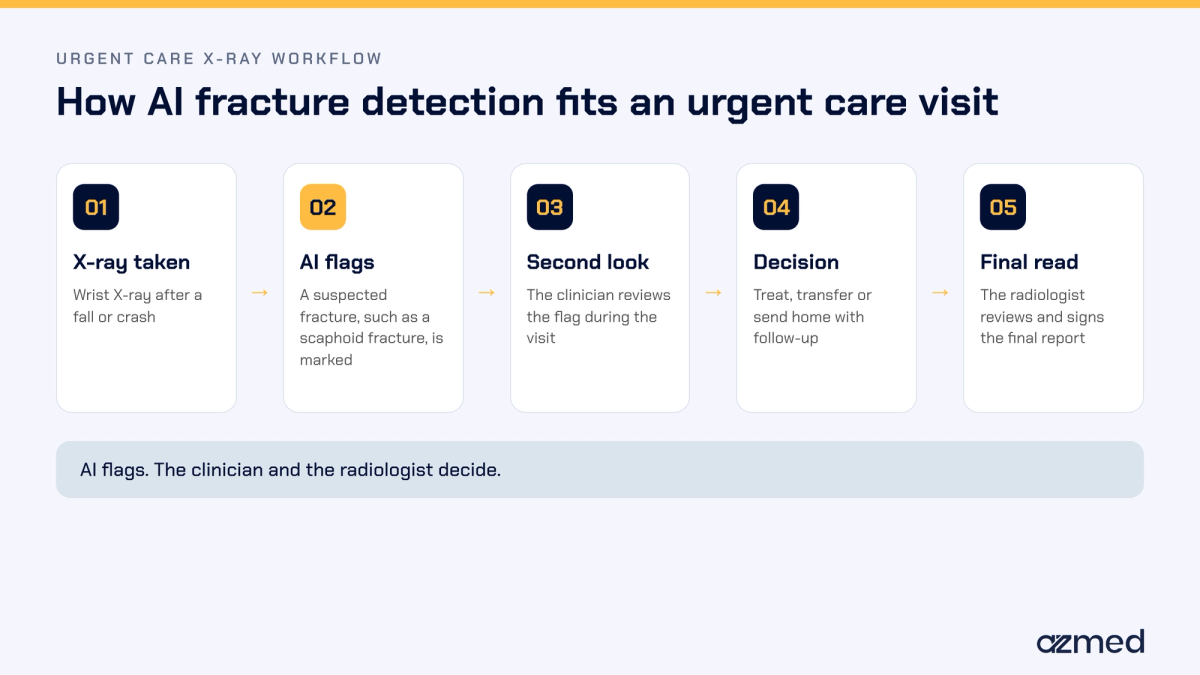
An initial use case for urgent care teams is to detect fractures and dislocations in extremity X-rays. Notably, this includes injuries that may be less obvious, such as the scaphoid fracture. Once AI flags a finding, clinicians get a second look, often before the patient leaves the clinic. For chest trauma, rib fractures and pneumothorax are examples of findings that can change the next step in care.
Florida teleradiology reads for an aging population
There are 1,931 diagnostic radiologists in the state of Florida, but 14 of the 67 counties in Florida are without a radiologist. According to the Florida Department of Health, 411 radiologists plan to change their scope of practice within the next five years.⁷ Approximately 21.2% of Floridians are 65 years of age and older. This number is greater than the national average of 16.8%. In nine of Florida's 67 counties, over 30% of the population is 65 or older.⁸
Older adults may suffer from falls related to their age, and the associated injuries can be quite severe. A hip fracture in older adults is among the most serious. Although there are 1,931 diagnostic radiologists in the state, there may not be a radiologist practice in the community to assist older patients.
In Miami-Dade County, the rate of fall hospitalizations for adults 65 and older increased by 52% between 2000 and 2022.⁹
How AI supports Florida teleradiology
In counties that do not have a local radiologist, a teleradiology group often reads X-rays remotely. The challenge for teleradiology groups is separating the urgency of an 80-year-old patient’s image of a potential hip fracture from that of a routine follow-up study.
Using AI to mark suspected fractures gives radiologists a second look during the read, so a subtle hip fracture is less likely to be missed. For the state of Florida, radiologist shortage solutions will have to function across distances. Patients may never meet in person with the radiologist who will read their images.
California emergency departments need urgent care to treat simple fractures
In 2023, California's emergency departments handled 14.9 million visits, a 17% increase from 2013, while the population has increased by only about 2%. Injuries and poisonings accounted for 18.2% of the visits, and 380,187 patients left the emergency department before receiving treatment. Emergency departments were also so full that they redirected incoming ambulances to other hospitals for a total of 165,804 hours in 2023, almost three times as many hours as in 2013.¹⁰
Urgent care can treat any simple fracture it can manage safely. The patient then no longer needs to visit an emergency department, which reduces crowding in those facilities. However, this can only happen if the urgent care team can trust their X-ray decision. AI fracture detection provides the clinician with an additional opportunity to verify X-ray images, ultimately reviewed by a radiologist on the final read. For California, urgent care is one of the most direct radiologist shortage solutions, because it relieves the burden on emergency departments.
In addition, California is experiencing a very heavy chest imaging burden. In 2024, the state had 2,109 reported cases of tuberculosis, a rate nearly double the national rate.¹¹ For groups that read high volumes of chest X-rays, AI highlights important abnormalities (such as consolidation, pleural effusions and nodules). This assists in prioritizing those patients whose radiographs require urgent attention. Although AI assists with the identification of abnormalities, it is the responsibility of both the treating physician and the radiologist to make the final diagnosis.
New Jersey urgent care sees the falls first
Every day, approximately 315 adults over the age of 60 visit an emergency department as a result of a fall in New Jersey. In 2024, falls resulted in 115,266 hospital-treated visits for this age group.¹² Patients in New Jersey also spend longer in the emergency department than the national median. The median visit lasts 186 minutes in New Jersey against 162 minutes nationally.¹³
Urgent care can serve as the initial point of contact for older patients who sustained minor injuries from a fall and are seeking medical care. The most critical findings are often the most subtle. Examples include a subtle fracture without any displacement, a joint effusion that suggests a hidden injury, or, in some cases, a dislocated joint. Failing to identify and treat these injuries promptly can lead to a return visit for the same injury. It can also mean missing the opportunity for an early diagnosis.
AI technology can recognize these types of injuries and alert the urgent care staff at the time of the visit. This can allow for a shorter urgent care X-ray read time and faster decision-making. This technology will also help the urgent care team decide which patients need a transfer to an emergency department. The team can then see which patients can go home with follow-up appointments.
In New Jersey, radiologist shortage solutions begin at the front door of care, where the team performs each patient's initial X-ray.
Pennsylvania teleradiology covers the gaps left by closures
The state of Pennsylvania has experienced a loss of 25 hospitals over the last ten years. It may experience additional hospital closures in the next five years, with estimates ranging from 12 to 14 potential closures. In Pennsylvania, approximately 37% of hospitals operate at a financial loss.¹⁴ A 2024 survey of 119 Pennsylvania hospitals indicated that approximately 14% of radiologic technologist positions were unfilled. Approximately 70% of surveyed hospitals also reported increased waiting times in their emergency departments.¹⁵
With hospital closures come large shifts in imaging volumes toward the remaining facilities and the teleradiology groups that read for them. These groups provide overnight reads and have to process a growing volume of studies from various hospital sites. Fracture detection gives remote radiologists a second look at extremity radiographs. Chest X-ray AI triage helps them find critical chest cases (e.g., pneumothorax and pleural effusion) in longer lists of studies. In Pennsylvania, radiologist shortage solutions are less about adding new readers than about enabling existing readers to manage higher volumes of studies from sites that no longer exist.
How can you know if AI is working as a radiologist shortage solution?
Teams should ultimately evaluate radiologist shortage solutions on the same variables they already track. Teleradiology groups and urgent care centers can evaluate five metrics before and after deployment. These include:
- Turnaround time for X-rays with urgent findings, from the time the image is acquired to the time the radiologist signs the final report.
- Number of studies read per radiologist per shift without an increase in discrepancies.
- Patient throughput per urgent care shift as well as the time spent by patients visiting the facility.
- How many patients return for a repeat visit or callback due to findings missed during their first visit.
- The number of patients transferred to an emergency department unnecessarily.

All five of these metrics directly relate to urgent care ROI and teleradiology margins. Shorter visits and fewer return visits allow urgent care centers to increase patient volume using the same number of employees. Faster reads of urgent studies allow teleradiology providers to serve more contracts without having to recruit new employees at the same rate that volume grows.
For additional insight into how radiologists can maintain control as artificial intelligence tools increase in use, see the analysis from RSNA 2026.
How AZmed supports teleradiology and urgent care teams in the US
AZmed supports teleradiology and urgent care teams across the US with the development of the Rayvolve AI suite for X-ray. AZtrauma is FDA-cleared in the US to help detect fractures across the limbs, pelvis, ribs and spine, as well as dislocations and joint effusions in specified anatomical areas and X-ray views. AZchest is FDA-cleared in the US to detect and localize pneumothorax, pleural effusion, consolidation and increased cardiothoracic ratio on frontal chest X-rays. A separate FDA clearance covers pulmonary nodule detection. AZtrauma and AZchest are able to integrate into existing PACS. Either the radiologist or the clinician who interprets the study makes all final decisions.
In Europe, our CE-marked products also provide osteo-articular measurements, bone age assessments and lung nodule detection via CT. To learn more about the way AZtrauma and AZchest will work with your region, your volume of patients and your staff, please reach out to our team.
Frequently asked questions
What are the best radiologist shortage solutions?
We believe the optimal radiologist shortage solution is a combination of teleradiology coverage, modifications to workflow, and, ultimately, the implementation of AI. It enables both radiologists and clinicians to more expeditiously read high-volume examinations (such as X-rays). AI is not intended to replace the radiologist. Rather, it assists the entire team in determining which images to read first among the volumes of images generated.
What is the difference between states concerning the radiologist shortage?
Each state is experiencing a radiologist shortage; however, the reasons for the shortage vary. In Florida, there are counties without any radiologists. Pennsylvania hospitals are closing. In California, New Jersey and Texas, emergency and urgent care departments face heavy volumes.
How does the use of AI assist urgent care centers with X-rays?
AI can flag certain findings (for example, fractures and dislocations) soon after the X-ray is taken, so the clinician can see them during the visit. This allows the clinician to make treatment decisions, referrals or transfers earlier in the process. The radiologist reviews these findings in the final report, which may arrive hours later.
Is it possible to decrease X-ray turnaround time in teleradiology using AI?
Yes, it is. When FDA-cleared triage software flags urgent chest findings in the radiologist’s teleradiology worklist, the radiologist is able to prioritize reading these studies. This has the effect of reducing the time required to complete the X-ray reports for those cases that require immediate attention.
References
- Pradhan A, et al. Academic Radiology. 2026. Reported in Radiology Business, Nearly 1 in 5 Americans live in true imaging deserts, with no local radiologists or scanners.
- American Society of Radiologic Technologists. ASRT Staffing and Workplace Survey. 2025.
- Texas Department of Transportation. Texas Motor Vehicle Traffic Crash Facts, Calendar Year 2024. 2025.
- Urgent Care Association. State of Texas. 2025.
- Texas Medical Association. Texas Physician Workforce. Texas Medicine. 2024.
- Texas Medical Association. Interstate Medical Licensure Compact. 2022.
- Florida Department of Health. Physician Workforce Annual Report 2025. 2025.
- Florida Office of Economic and Demographic Research. Econographic News 2024. 2024.
- Florida Department of Health in Miami-Dade County. Trends in Causes of Injury Hospitalizations, Age 65+, 2000 to 2022. 2025.
- California Health Care Foundation. California Emergency Departments Almanac. 2025.
- California Department of Public Health. TB in California, 2024 Snapshot. 2025.
- New Jersey Division of Aging Services. Falls Fact Sheet 2025. 2025.
- Becker's Hospital Review. ED visit times, by state. 2026.
- Hospital and Healthsystem Association of Pennsylvania. Report: More hospital closures likely without increased support. 2026.
- Becker's Hospital Review. What's delaying care in Pennsylvania. 2025.
Regulatory information
US - Medical device Class II according to the 510K clearances. Rayvolve: is a computer-assisted detection and diagnosis (CAD) software device to assist radiologists and emergency physicians in detecting fractures during the review of radiographs of the musculoskeletal system. Rayvolve is indicated for adult and pediatric population (≥ 2 years).Rayvolve PTX/PE: is a radiological computer-assisted triage and notification software that analyzes chest x-ray images of patients 18 years of age or older for the presence of pre-specified suspected critical findings (pleural effusion and/or pneumothorax). Rayvolve LN: is a computer-aided detection software device to assist radiologists to identify and mark regions in relation to suspected pulmonary nodules from 6 to 30mm size of patients of 18 years of age or olderEU - Rayvolve: Medical Device Class IIa in Europe (CE 2797) in compliance with the Medical Device Regulation (2017/745). Rayvolve is a computer-aided diagnosis tool, intended to help radiologists and emergency physicians to detect and localize abnormalities on standard X-rays.Caution: The data mentioned are sourced from internal documents, internal studies and literature reviews. This material with associated pictures is non-contractual. It is for distribution to Health Care Professionals only and should not be relied upon by any other persons. Testimonial reflects the opinion of Health Care Professionals, not the opinion of AZmed. Carefully read the instructions for use before use. Please refer to our Privacy policy on our website For more information, please contact contact@azmed.co.AZmed 10 rue d’Uzès, 75002 Paris - www.azmed.co - RCS Laval B 841 673 601© 2026 AZmed – All rights reserved. MM-26-41